Why the headphone socket disappeared
The jack port took up a lot of internal space, required an opening in the frame and made waterproofing harder. Removing it freed room for the battery and simplified the design. In practice, a wired headset, a car stereo or a hi-fi system can no longer be plugged in directly.
The converter that turned the digital signal into an analogue one used to sit in the phone. It now lives in the adapter itself, and that small circuit decides the quality of the sound you hear.
What separates two adapters that look alike
- The quality of the converter. A basic circuit adds audible hiss in quiet passages, and caps the volume on demanding headphones.
- Microphone support. A headset with four contact points also carries your voice. Not every adapter passes that channel through, which makes calls impossible.
- Headset controls. Volume, pause, answering a call: they go through the same connector and only work if the adapter passes them on.
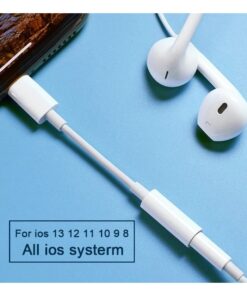
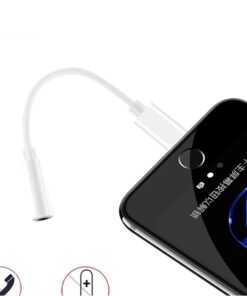
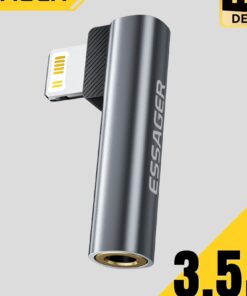
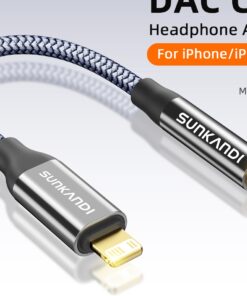
- Cable length. Too short and it pulls on the port, too long and it tangles. About ten centimetres is the usual compromise, as on our Lightning to 3.5 mm adapter with braided cable.
Charging and listening at the same time
A simple adapter takes up the port and prevents charging. It is the limit that bothers people most in the car and on long journeys. A dual-output model, jack plus charging port, solves the problem at the cost of extra bulk and sometimes narrower compatibility with fast chargers.
Wired keeps two real advantages
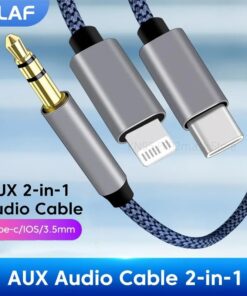
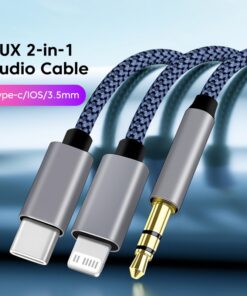
Compared with Bluetooth, a wired link keeps two advantages that are beyond debate. There is no latency, which matters for gaming, video editing and any use where picture and sound must stay in sync. And there is nothing to recharge: a wired headset works as long as the phone does. For a car stereo with an aux input only, our 2-in-1 jack adapter comes in three versions.
The downside is that the adapter is one more small part that gets lost. Leaving it permanently on the headset rather than on the phone is the best way to stop looking for it. Our Lightning to 3.5 mm audio adapter weighs only a few grams.
What explains missing or distorted sound
- Dirty contacts in the phone's port. A puff of air is enough, never a metal object.
- A headset with four contacts on an adapter that only handles three, which cuts the microphone and sometimes one channel.
- Volume capped by the system's hearing safety setting, active by default in the European Union.
- An adapter that is no longer recognised after an update, rare but real with the cheapest models.
Frequently asked questions
Will my headset microphone work?
Only if the adapter passes the microphone channel through and the headset has four contact points. Check this if you make calls with it.
Can I use it with a car stereo?
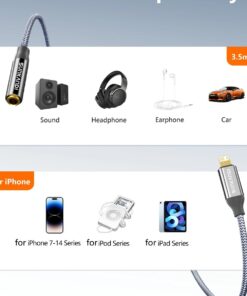
Yes, with a jack-to-jack cable plugged into the adapter. It is the most common use in cars without Bluetooth.
Is the quality lower than the original socket?
With a decent adapter, the difference is inaudible in normal use. It shows on demanding headphones, where a dedicated external converter will do better.
Does it still work after a phone update?
In the vast majority of cases, yes. Incompatibilities mainly affect the most basic adapters, whose circuit is not recognised.